


 Brides in Stockholm who want their fathers to walk them down the aisle are likely to be told it can’t be done, as some pastors are refusing to allow the practice they say is sexist.
“In Sweden we have worked hard in many different ways to eliminate everything that is unequal,” a Lutheran Church vicar in the Stockholm region, Yvonne Hallin, said.
 The Rev John Thomas, president of the US United Church of Christ, has been arrested in a protest about the Iraq war outside the White House in Washington DC.
 With our news media being full of ‘bad’ news and graphic images of violence and war, and the fact that good things don’t seem to rate, an article by Richard Eckersley that recently appeared in The Age puts to words some things I have been thinking of late.
In this article, he speak of the ways we can make a difference by choosing how we respond to these things.
The latest newsletter resource from Christianity 9 to 5 is now available here.
Christianity 9 to 5 is an online newsletter aimed at providing practical resources for Living Faith at Work.
A British university department dedicated to exploring the relationship between sport and spirituality has launched itself internationally by staging an inaugural conference for sports coaches, chaplains and administrators, as well as professional athletes and academics.
More than 70 delegates from 11 countries recently met at the Centre for the Study of Sport and Spirituality, which is part of York St John University in northern England, to look at the spiritual and moral issues involved in their work – writes Martin Revis for ENI.
 Archbishop of Canterbury Dr Rowan Williams has said that Richard Dawkins and other apostles of anti-religious sentiment are oversimplifying complex issues and often missing the point. His comments came in a weekend lecture on ‘misunderstanding religion’ at the University of Swansea.
Wesley Mission has called for an end to discrimination in the workplace, more flexible employment opportunities and increased funding for community based care as part of a 21-point reform plan to address the major issues impacting people with mental illness.
Recently the milkman returned to Oakleigh. Aussie Farmers direct are ‘taking the guess work out of buying Australian’ by home delivering milk and a limited range of produce twice a week. This is aimed to directly support farmers and give them a greater share of profits, rather than giving most of the profit to large foreign-owned multi-nationals. They also claim to supply things cheaper and fresher than large supermarkets.
Is this good for farmers? Is it good for corner shops? Is it good for Australia? We invite your comments …
 The time has come when ethical investments are out-performing regular ones. With carbon trading, global warming, renewable energy and similar things becoming mainstream, those who invest according to biblical principles are actually reaping the rewards.
 – What the growing gap in our culture means for churches, leaders, and volunteers.
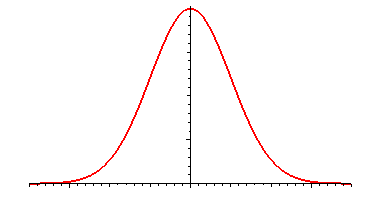
A while back I heard Len Sweet say that our society is moving away from the “bell curve” and toward something called the “well curve.” His comment got me doing some research on the topic and thinking about what all of this means for church leaders. Who knew that bells and wells were such important topics for church leaders to consider?
Since high school we’ve known all about the bell curve: that fundamental law of natural science and statistics that defines normal distribution as being massed near the middle while being low on the extremities. Represented on a graph, the distribution looks like a bell-shaped curve. The bell curve implies that most people gravitate toward the middle or average and avoid the extremes. For example, most people are of average height, have moderately sized families, and earn a “C” in statistics; few people are really tall or really short, few have very large or very small families, and few earn A’s or F’s.